

Health Canada has released a draft Quality of Natural Health Products Guide for consultation, proposing the most significant update to NHP quality guidance since the finalized Good Manufacturing Practices (GMP) Guide for Natural Health Products (GUI-0158, Version 4.0). Replacing the 2015 Quality Guide if finalized, the draft reflects advances in analytical science, manufacturing practices, modern dosage forms, and international quality standards, while fundamentally expanding how quality is expected to be managed throughout an NHP’s lifecycle.
Rather than focusing primarily on Product Licence Applications, the proposed guide positions quality as a continuous process spanning raw material characterization, Finished Product Specifications (FPS), manufacturing, product release, stability, post-licensing changes, importation, and post-market activities. It also introduces substantially expanded guidance on analytical methods, dosage form performance, impurities and contaminants, packaging, probiotics, and stability testing.
Together with the new GMP Guide, this consultation represents the next phase in Health Canada’s modernization of the Natural Health Products regulatory framework. Companies should review the proposed changes carefully, assess the potential impact on their quality systems and product specifications, and consider participating in the consultation before the guidance is finalized.
In recent years, Health Canada has undertaken the most comprehensive modernization of the Natural Health Products (NHP) regulatory framework since the Natural Health Products Regulations came into force in 2004. Rather than introducing a single regulatory change, the department has been systematically updating the guidance documents that define how quality is established, maintained, and demonstrated throughout a product’s lifecycle.
The first major milestone was the publication of the Good Manufacturing Practices (GMP) Guide for Natural Health Products (GUI-0158, Version 4.0) in September 2025. That guidance significantly expanded industry expectations around quality systems, governance, documentation, supplier oversight, risk management, and the responsibilities of manufacturers, importers, distributors, and Quality Assurance Persons (QAPs). It marked a clear shift toward modern pharmaceutical quality system principles while maintaining a flexible, risk-based approach appropriate for the diverse NHP sector.
Health Canada’s newly proposed Quality of Natural Health Products Guide represents the next phase of that modernization effort. Rather than focusing on how products should be manufactured, the draft guidance focuses on how product quality should be scientifically established, documented, verified, and maintained throughout the entire lifecycle of an NHP.
While the existing 2015 Quality of Natural Health Products Guide (Version 3.1) places substantial emphasis on supporting Product Licence Applications, it already recognizes that specifications and quality information must be maintained after licensing and addresses responsibilities related to GMP, stability and third-party arrangements. The proposed guide builds on this foundation by providing a much more detailed and operational framework for raw material characterization, analytical methods, Finished Product Specifications (FPS), release testing, stability programs, packaging compatibility, product development and post-licensing changes. Many topics previously addressed at a high level have been expanded to reflect advances in science, manufacturing technologies, modern dosage forms and internationally recognized quality standards.
Taken together, the new GMP Guide and the proposed Quality Guide establish a complementary framework for NHP compliance. The GMP Guide defines the quality systems and operational controls that manufacturers and other regulated parties are expected to implement, while the Quality Guide defines the scientific principles, testing strategies, and documentation needed to demonstrate that products consistently meet those quality requirements. For many companies, this represents a shift from viewing quality as a licensing exercise to treating it as a continuous process that extends from product development through commercial manufacturing and throughout the product’s market life.
The proposed Quality of Natural Health Products Guide applies to virtually every stakeholder involved in the development, manufacture, testing, importation, and maintenance of Natural Health Products (NHPs). Like the existing guide, it applies broadly to all categories of NHPs, including non-sterile products, sterile products, homeopathic medicines, and traditional medicines. However, the proposed draft significantly expands the contexts in which the guidance is intended to be used.
Rather than focusing primarily on the quality information required to support a Product Licence Application (PLA), the draft guide positions Finished Product Specifications (FPS) as central quality documents that support activities throughout the product lifecycle. In addition to product licensing and post-licensing amendments, the guidance is intended to support raw material characterization, product development, contract manufacturing, release testing, stability programs, site licence activities, import verification, and post-market quality management.
The draft also broadens the intended audience. While the current guide is written mainly from the perspective of applicants and product licence holders, the proposed guidance explicitly addresses formulation developers, manufacturers, contract manufacturers, packagers, labellers, importers, Quality Assurance Persons (QAPs), testing laboratories, regulatory consultants and others involved in establishing or verifying product specifications. This makes the shared and cross-functional nature of NHP quality responsibilities more explicit and reinforces the need for coordination among regulatory, manufacturing, laboratory and quality-assurance functions.vFor companies already adapting to the new GMP Guide, this draft reinforces Health Canada’s expectation that product quality should be managed as an integrated system rather than as separate regulatory, manufacturing, and laboratory activities. Organizations that manufacture, import, test, or release NHPs should expect these functions to become increasingly interconnected as the modernization of the NHP regulatory framework continues.
One of the clearest themes throughout the proposed guidance is that Health Canada has shifted from viewing quality as a requirement for obtaining a product licence to treating it as a continuous responsibility that extends throughout the entire lifecycle of an NHP.
The table below highlights some of the most significant differences between the 2015 Quality of Natural Health Products Guide (Version 3.1) and the proposed 2026 Draft Quality Guide, illustrating how Health Canada’s expectations have evolved over the past decade.
| Area | 2015 Quality Guide (Version 3.1) | 2026 Draft Quality Guide | Why It Matters |
| Overall philosophy | Establishes product licence holder responsibility for specifications and ongoing product quality, with substantial emphasis on the licensing process. | Introduces a lifecycle quality framework spanning development through post-market activities. | Quality becomes an ongoing responsibility, not simply a licensing exercise. |
| Primary audience | Written mainly for applicants and product licence holders, while recognizing responsibilities delegated to manufacturers, importers, laboratories and other third parties. | Explicitly includes formulation developers, manufacturers, packagers, importers, QAPs, laboratories, consultants and others. | Recognizes that quality responsibilities extend across the supply chain. |
| Finished Product Specifications (FPS) | Requires FPS to be established, maintained and updated, but provides less operational direction on their use in release, stability and lifecycle change management. | FPS becomes a living quality document supporting release, stability, manufacturing, amendments and post-market maintenance. | Companies will need stronger processes for maintaining specifications over time. |
| Product lifecycle | Addresses GMP, third-party responsibilities, stability and post-licensing maintenance at a relatively high level. | Covers raw materials, development, manufacturing, release, stability, importation and post-market activities. | Connects regulatory compliance with day-to-day quality operations. |
| Analytical methods | General discussion of acceptable testing. | Significantly expanded expectations for validation, verification, equivalency, traceability and method transfer. | Greater evidence will be needed to support laboratory methods. |
| Dosage forms | Covers core solid, liquid, topical, transdermal and metered-dose forms but does not provide the same level of product-specific direction—particularly for gummies and oral pouches. | Adds extensive guidance for gummies, sprays, transdermals, oral pouches, suspensions and other modern dosage forms. | Reflects today’s NHP marketplace. |
| Performance testing | General requirements for disintegration, dissolution and uniformity. | Detailed dosage-form-specific testing recommendations and decision tables. | More consistency in selecting appropriate release and stability tests. |
| Quantification by input | Permitted with limited discussion. | Requires substantially stronger scientific justification and supporting evidence. | May affect many botanical and complex formulations. |
| Elemental impurities | Existing contaminant limits. | Updates limits using a framework more closely aligned with ICH Q3D and permitted daily exposures. | Some contaminant limits become more stringent while assessment methodology changes. |
| Impurities & contaminants | Focuses on traditional contaminants. | Expands expectations for nitrosamines, degradation products, extractables, leachables, mutagenic impurities and other emerging risks. | Modernizes impurity control expectations. |
| Packaging | Minimal discussion. | Packaging compatibility becomes part of documented product quality. | Container selection becomes a scientific quality consideration, not simply a packaging decision. |
| Stability | General guidance. | Much more detailed expectations for packaging configurations, transportation, in-use stability and storage conditions. | Stability programs become significantly more comprehensive. |
| Probiotics | Includes species and strain identification, genomic characterization, viable-count requirements, microbial purity and certain virulence controls. | Expands genomic criteria and introduces more detailed antimicrobial-resistance, resistance-transferability, virulence-gene, toxin and vulnerable-population controls. | Reflects advances in microbiological science since 2015. |
| Post-licensing maintenance | Requires specifications and quality information to be maintained after licensing, including updates following changes to quality expectations. | Provides more explicit direction on updating FPS as monographs, pharmacopoeias, methods, suppliers and products evolve and determining whether an amendment is required. | Product licences will require more active lifecycle management. |
| Alignment with GMP | References GMP where applicable. | Closely integrates with the new 2025 GMP Guide and Quality Assurance Person responsibilities. | Reinforces Health Canada’s move toward a unified quality framework. |
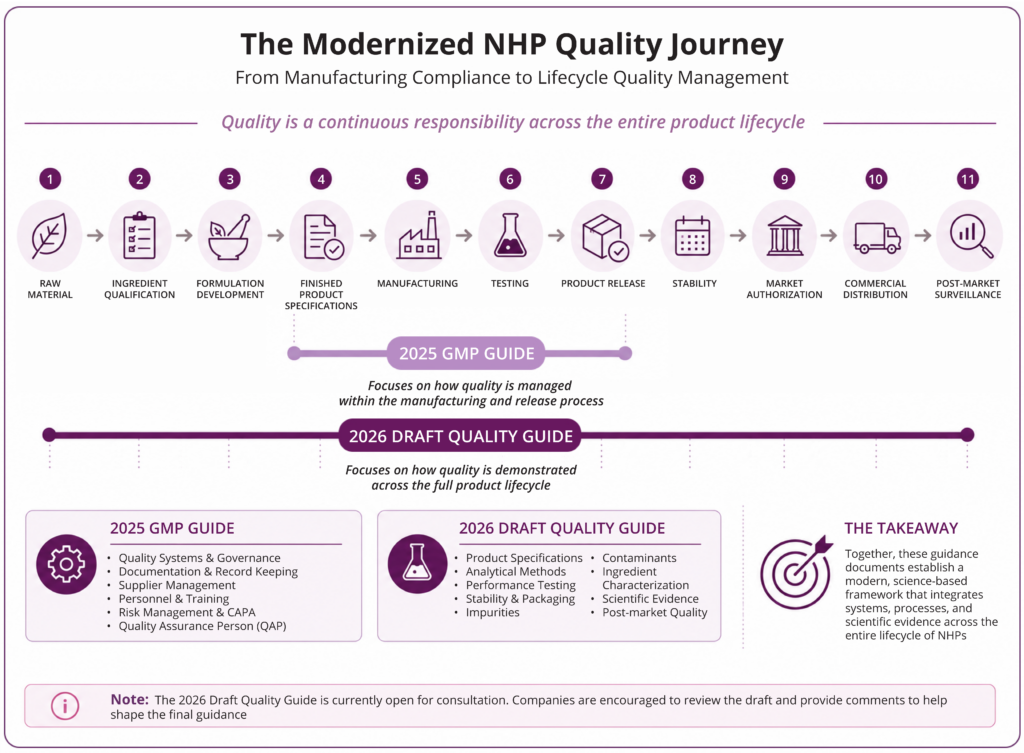
The proposed guide contains numerous technical revisions, but several recurring themes demonstrate how Health Canada intends to clarify and expand its interpretation of existing NHP quality requirements. The draft connects product development, manufacturing, testing and post-market quality maintenance more directly while providing more detailed recommendations for specifications, analytical methods, performance testing, stability and product-specific risks. Many of these changes elaborate on responsibilities that already exist under the Natural Health Products Regulations and GMP principles rather than creating entirely new regulatory obligations.
1. Lifecycle Quality Responsibilities Become More Explicit
The proposed guide makes the lifecycle management of quality much more explicit, connecting raw material characterization, product development, manufacturing, release testing, stability, post-licensing changes and post-market quality activities. This aligns closely with the recently finalized GMP Guide and reinforces Health Canada’s expectation that quality should be actively maintained throughout a product’s commercial lifecycle rather than demonstrated only at the time of licensing.
2. Finished Product Specifications Take on a More Operational Role
The draft more clearly positions Finished Product Specifications (FPS) as living quality standards used throughout manufacturing, product release and post-licensing maintenance.. The draft places much greater emphasis on maintaining current specifications as formulations, pharmacopoeias, monographs, analytical methods, and regulatory requirements evolve. Companies will need stronger change management processes to ensure specifications remain aligned with both manufacturing practices and regulatory expectations.
The draft also changes how reduced and rotational testing schedules are documented. The current guide states that a reduced testing schedule should be identified on the FPS. Under the proposed approach, the FPS submitted to Health Canada would instead describe the complete specification, while any reduced or rotational testing program would be scientifically justified and managed through the company’s GMP system.
3. Scientific Evidence Requirements Continue to Increase
Health Canada significantly expands expectations for analytical methods, including validation, verification, equivalency, method transfer, and documentation. Alternative methods remain acceptable where scientifically justified, but companies are expected to provide considerably more evidence supporting their testing strategies. The overall direction reflects a move toward greater scientific rigor and internationally recognized laboratory practices.
4. The Guidance Reflects Today’s NHP Marketplace
The 2015 guide was written before many of today’s most common dosage forms became widespread. The proposed guide provides expanded or more specific expectations for gummies, oral pouches, transdermal products, sprays, modified-release formulations, and other modern dosage forms, including dosage-form-specific performance testing recommendations that better reflect current manufacturing practices.
Gummies for example—described in the draft as “chewable gels”—receive specific performance criteria. The draft generally proposes disintegration within not more than 15 minutes unless appropriate dissolution testing is used. It also recommends a weight-variation limit of no more than ±7.5%, compared with the general ±10% criterion applicable to many other solid dosage forms.
5. Stability and Packaging Receive Much Greater Attention
The draft substantially expands guidance around stability studies by considering packaging configuration, transportation, storage conditions, in-use periods, and consumer use after opening. Packaging is no longer treated simply as a container—it becomes part of the documented quality assessment, with greater emphasis on compatibility, protection, and potential interactions between the product and its packaging system.
The draft also states that separate stability studies should generally support each packaging presentation—for example, where the same tablets are marketed in both bottles and blister packs. It provides more detailed expectations for in-use periods, refrigerated products, freeze-thaw exposure and multidose products after opening.
6. Impurity and Contaminant Controls Are Modernized
While contaminant testing has always formed part of NHP quality, the proposed guide significantly broadens the scope of impurities companies should consider. Updated elemental impurity approaches, expanded contaminant testing, and new discussions around nitrosamines, degradation products, extractables, leachables, and other emerging quality risks bring the guidance closer to contemporary international quality standards. The proposed limits do not all move in the same direction; some become more stringent, while others increase or are assessed using a different framework.
Several elemental-impurity limits would also change. For adult oral products, the draft decreases the daily limits for lead from 10 µg to 5 µg, cadmium from 6 µg to 5 µg and total mercury from 20 µg to 15 µg. However, the proposed total arsenic limit increases from 10 µg to 15 µg, while the listed inorganic arsenic limit increases from 2.1 µg to 15 µg. The proposed changes are therefore not uniformly more stringent.
The draft also retains the 20 ppm limit supporting a gluten-free claim but lowers the limit for a sulphite-free claim from 20 ppm to 10 ppm. The relevant analytical method would need to appear on the FPS.
7. Product Complexity Requires Greater Scientific Oversight
Some of the most detailed revisions focus on increasingly complex products, particularly botanicals and probiotics. Expanded expectations for ingredient characterization, quantification by input, genomic identification, antimicrobial resistance, and population-specific quality considerations demonstrate Health Canada’s recognition that modern NHPs require more sophisticated scientific oversight than they did a decade ago.
For products relying on quantification by input, the draft also establishes more detailed supporting expectations. Companies may need to demonstrate why a suitable finished-product assay could not be implemented despite reasonable efforts and maintain evidence addressing method limitations, ingredient or matrix interference, batch records, ingredient expiry dates, blend homogeneity and finished-product content uniformity.
Most probiotics would continue to be expected to meet at least 80% of the labelled viable count at the end of shelf life. However, products or ingredients associated with a serious health risk would be expected to meet 100% of the labelled claim, where that level is supported by the scientific evidence. The draft also adds more detailed genomic, antimicrobial-resistance, resistance-transferability, virulence and vulnerable-population controls.
Although the proposed Quality Guide remains in draft form, it provides valuable insight into the direction Health Canada is taking. Organizations that wait until the guidance is finalized may find themselves needing to make significant updates to quality documentation, testing strategies, and internal procedures under compressed timelines. Reviewing the draft now allows companies to identify potential gaps, assess the impact on existing products, and plan for future compliance.
One of the first areas organizations should evaluate is their Finished Product Specifications (FPS). Under the proposed guidance, FPS are expected to serve as comprehensive quality documents that support product licensing, manufacturing, release testing, stability programs, and ongoing post-market maintenance. Companies may wish to assess whether their existing specifications remain scientifically justified, adequately documented and aligned with current formulations, manufacturing practices, analytical methods, certificates of analysis and release procedures.
Laboratory methods should also be reviewed. The draft provides considerably more detailed direction on analytical method validation, verification, equivalency, transfer and scientific justification than the current guide. Organizations relying on alternative methods, contract laboratories or legacy procedures may wish to confirm that the method source is clearly identified and that sufficient documentation exists to demonstrate suitability for the specific ingredient or finished-product matrix.
Manufacturers of newer dosage forms—including gummies, sprays, oral pouches, transdermal products, and modified-release formulations—may wish to assess whether current performance testing adequately demonstrates product quality. Likewise, companies developing botanical products or probiotics should review the expanded expectations around ingredient characterization, identity testing, and product-specific quality controls.
Finally, organizations should view this consultation as an opportunity to evaluate their overall quality management framework. The proposed guide reinforces that regulatory affairs, quality assurance, manufacturing, and laboratory operations are increasingly expected to function as an integrated system. Strengthening communication between these functions today will help position companies for a smoother transition once the guidance is finalized.
Health Canada is accepting comments on the draft guidance as part of its public consultation process until September 20, 2026. The department intends to publish a final version later in 2026, Companies that anticipate a significant operational impact should consider reviewing the document in detail and providing feedback before the consultation closes. Participation allows industry to help clarify technical expectations and identify practical implementation challenges before the guidance becomes final.
Health Canada is accepting comments on the draft Quality of Natural Health Products Guide until September 20, 2026. Product licence holders, manufacturers, importers, packagers, labellers, testing laboratories, healthcare professionals, industry associations, and other stakeholders are encouraged to review the draft and provide feedback.
When preparing comments, Health Canada recommends using the PDF version of the draft guidance, which includes line numbers in the left margin to help identify the specific sections being referenced. Stakeholders may also find it helpful to compare the draft against the current 2015 Quality of Natural Health Products Guide when evaluating proposed changes.
Comments can be submitted by email to nnhpd.consultation-dpsnso@hc-sc.gc.ca. Health Canada has indicated that it will review all feedback received before publishing a final version of the guidance, with an appropriate transition and implementation period to follow.
For organizations that manufacture, import, test, or market Natural Health Products in Canada, this consultation provides an opportunity to help shape guidance that is expected to influence quality expectations for years to come.
Taken together, the finalized GMP Guide and the proposed Quality Guide signal a broader evolution in how Health Canada approaches Natural Health Product oversight. One establishes the systems and controls needed to manufacture quality products; the other defines the scientific evidence needed to demonstrate that those products consistently meet appropriate quality standards.
For many organizations, compliance will increasingly depend not only on meeting individual regulatory requirements, but on maintaining a robust quality framework that integrates product development, analytical science, manufacturing, and post-market quality management. Companies that begin evaluating these expectations now will be better positioned to adapt as Health Canada’s modernization of the NHP regulatory framework continues.
As regulatory expectations continue to evolve, understanding how proposed guidance may affect existing products, quality systems, and future submissions is becoming increasingly important. Whether you’re preparing a Product Licence Application, reviewing Finished Product Specifications, validating analytical methods, or assessing the impact of the proposed guidance on your quality program, early planning can help reduce implementation challenges once the guidance is finalized.
dicentra’s regulatory scientists and quality specialists work with manufacturers, importers, and product licence holders across the Natural Health Product lifecycle, providing scientific and regulatory support for product licensing, quality documentation, GMP compliance, analytical strategies, and post-market maintenance. By monitoring emerging regulatory developments and translating them into practical compliance strategies, we help organizations navigate regulatory change with confidence.
Have questions about the proposed Quality of Natural Health Products Guide? Contact the dicentra team to discuss how the draft guidance may affect your products, quality systems, or regulatory strategy.